Archive for the ‘New Technology’ Category

A New Kindle; Closer to the Magic $99 Price

Thursday, July 29th, 2010

Amazon has released a new, smaller and less expensive Kindle in two versions; the Kindle Wi-Fi is just $139 and the Kindle, with both Wi-Fi and 3-G is $189 (Amazon’s promotional video is available here).

Reviewing it, the Washington Post says it’s the first Kintle that fits comfortably in one hand, is better designed ergonomically and that the display is dramatically better, summing it up as  ”a winner poised to top the pack.”

Newsweek says to dismiss it as “nice, but no iPad” would be “too bad, because the new model is a pretty slick little device, despite the fact that it still has only a black-and-white screen and is only good for reading books and newspapers.”

Both versions are now available for pre-order and will ship August 27th.

Hardcovers vs. Kindles

Tuesday, July 20th, 2010

Amazon, facing Wall Street’s concern about competition from the iPad (the stock is down 16% in the last three months), announced yesterday that sales of ebooks are outstripping sales of hardcovers. In the last three months, for every 100 hardcovers, Amazon sold 143 books in Kindle format. In the last month, the rate has increased to 180 ebooks to 100 hardcovers.

This is significant news, if not the “tipping point” that Amazon claims (as of May, according to the AAP, ebook sales are 8.48% of trade sales; adult hardcovers are 43.2%).

Amazon doesn’t reveal actual numbers, just comparisons, so it’s important to remember a couple of things;

Ebooks are being compared to hardcovers, but paperbacks are still the strongest sales category for Amazon

In June, Amazon lowered the price of the Kindle, tripling sales of the device. All those new Kindle owners did what anyone with a new toy does; they bought software to go with the hardware.

For information on actual sales, we have to turn to estimates. NPR’s Morning Edition quotes an analyst at Forrester Research who says there may be 6 million devices in the market right now, most of them Kindles and that by the end of the year, the total may be close to 11 million.

WSJ on the Internet Archive

Thursday, July 1st, 2010

The nonprofit digital library, Internet Archive has created the “Digital Lending Library” (Openlibrary.org), a project that scans public domain books and makes them available for borrowing through libraries. The project is covered in the Wall Street Journal.

The scanned books are available through OverDrive’s Digital Library Reserve.

The story is also covered in a WSJ video:

Mining the Backlist

Friday, June 25th, 2010

The ability to slice and dice content digitally, giving new life to backlist titles, is often touted as a major advantage for publishers. Often touted, but so far, rarely used.

Simon and Schuster just announced that they are releasing an eBook called Truman Fires MacArthur, about the event that is the historical precedent of “Obama Fires MacChrystal.” The ebook is an excerpt of David McCullough’s 1992 Pulitzer Prize winning bio, Truman.

It appears the excerpt is not available to libraries. However, the full book is available electronically through OverDrive.

In her L.A. Times blog “Jacket Copy,” Carolyn Kellogg notes calls this a smart move by S&S’s brand-new publisher, Jonathan Karp, the former publisher and founder of the Grand Central imprint Twelve, and says it  bodes well for  his leadership of S&S.

By the way, for libraries that haven’t already done so, this is a good reminder to bring the book out of the stacks and display it.

Truman
David McCullough
Retail Price: $22.00
Paperback: 1120 pages
Publisher: Simon & Schuster – (1993-06-14)
ISBN / EAN: 0671869205 / 9780671869205

BEA eCatalog by Edelweiss

Tuesday, June 1st, 2010

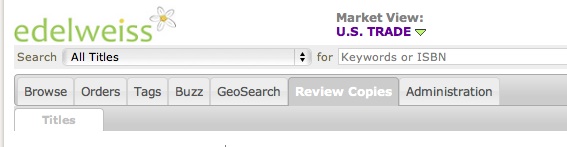
If you didn’t get to BEA, or even if you did and feel that you missed a few publishers, Edelweiss has created an online catalog of titles that were at the show. It’s worth checking out, if only to get a glimpse of the future of publishers catalogs.

The Edelweiss catalog offers several advantages over print. You can browse all the catalogs by genre, allowing you to look at all 332 cookbooks that were exhibited, and further letting you to narrow the search down to the 17 Vegetarian and Vegan books (hey, look at that, there’s a vegan book for “Latin Food Lovers”).

The GeoSearch tool (accessible from the tabs across the top) is a new function from Edelweiss, allowing you to find books related to your local area. I used it to discover that a new book on the Auburn Cord Duessenberg Racers is coming in October; it’s within driving distance of my former high school. This works with publishers full catalogs, too; get to them via the “Switch Market View” tab at the very top.

Under specific title pages, you will find publishing background you won’t find elsewhere. For instance, the first novel, Juliet, which was one of the picks for the librarian’s “Shout ‘n’ Share” program, will be getting quite a bit of promotion when it is released in August; clearly, the publisher has already invested heavily in it, as evidenced by this note:

HOT TITLE!: The talk of 2008’s Frankfurt Bookfair, this debut novel was preempted by Ballantine on the morning of what promised to be a highly competitive auction. Write-ups about the novel appeared in all the publishing press. Foreign rights were subsequently sold in twenty-nine territories.

Edelweiss also lets you see how the book is being discussed on Twitter and, if you register with Edelweiss, you can tag titles, to create lists accessible from the navigation bar at the top.

Hurry, though, the BEA listings will only be up through June 11th.

A Bookless Library

Wednesday, May 19th, 2010

Stanford University’s Physics and Engineering Libraries are undergoing some very heavy weeding. The two libraries are being turned into a smaller electronic library, according to the San Jose Mercury News. The new facility “saves its space for people, not things. It features soft seating, ‘brainstorm islands,’ a digital bulletin board and group event space,” as well as access to online databases and scientific journals.

An eBook Crash?

Wednesday, May 12th, 2010

On AOL’s DailyFinance blog, Sarah Weinman surveys the many devices and formats for eBooks in “How to Navigate the Confusing E-Book Landscape” and warns,

…device makers must be on guard that the constant confusion and lack of consistency may precipitate a crash akin to the Great Video Game Crash of 1983. The e-book market may be a lot more mature than it was a decade ago, but it still has a long way to go before it fully grows up.

The iPad Cometh

Thursday, April 1st, 2010

It may seem anti-climactic, after all the hoopla preceding its announcement back in January, but the iPad arrives in stores on Saturday.

Many have predicted it will be “the Kindle killer,” but in the NYT today, David Pogue’s review indicates otherwise,

There’s an e-book reader app, but it’s not going to rescue the newspaper and book industries (sorry, media pundits). The selection is puny (60,000 titles for now). You can’t read well in direct sunlight. At 1.5 pounds, the iPad gets heavy in your hand after awhile (the Kindle is 10 ounces). And you can’t read books from the Apple bookstore on any other machine — not even a Mac or iPhone.

In USA Today, tech columnist, Edward C. Baig, likes how books appear on the iPad,

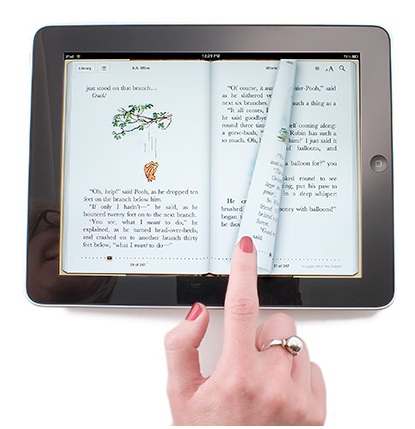
Judged solely from a sizzle standpoint: There’s no contest. Titles on the iPad such as Winnie the Pooh (which comes preloaded on the iPad) boast colorful illustrations. The 6-inch Kindle screen is grayscale.

But, like Pogue, he objects to the weight of the device, “Curling up in bed was more comfortable with a 10.2-ounce Kindle than with the weightier iPad,” and the backlit screen, which may prove tiring when reading a long book. He also points out that the Kindle is much cheaper (he suggests that they will need to drop the price even further) and has longer battery life.

The following video from USA Today demonstrates the device (ironically, this video cannot be viewed on an iPad; it doesn’t play Flash).

Espresso Book Machine Aids Haiti

Friday, February 12th, 2010

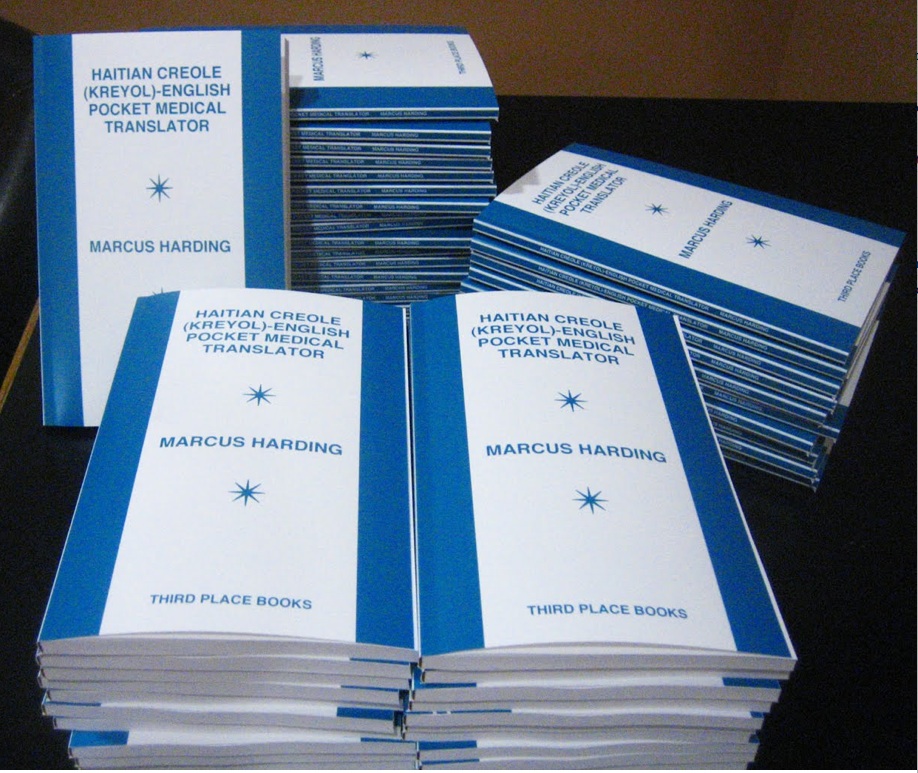
Three booksellers used their print-on-demand Espresso Book Machines to create copies of the Haitian Creole (Kreyol) Pocket Medical Translator for relief workers in Haiti. According to a report in the Grand Rapids Press (the local Schuler Books & Music is one of the participating stores), the project was originated by Google, which waived the fee for accessing the title and is underwriting shipping costs.

During a panel at the American Booksellers Association’s Winter Institute last week, booksellers talked about their experiences with the machines. Shelf Awareness reports today that they are popular for self-published works. One bookseller said people get very excited about finally seeing their book in print; “I go downstairs when I know an author is coming in so I can witness that exchange.”

This week; The Christian Science Monitor ran a post on about two Seattle-area stores that have installed the machine. One of them, Third Place Books, has a blog devoted to the store’s experiences in on-demand printing, including a visit from a group of librarians from Bainbridge Island, who “thoroughly grilled [the staff] on the EBM’s promise to books, retailing, and libraries.”

For those of you not able to grill the Third Place Books staff, they have provided a helpful FAQ on the machine. You may also want to check the  list of Espresso Book Machine locations to find one near you. The only public library on that list is New Orleans (NYPL exhibited the machine in 2007).

Publishers Gain Leverage with Google

Tuesday, February 9th, 2010

The NYT reports today that publishers’ “conversations with Google have taken a more flexible tone” since the unveiling of the iPad and Amazon’s concessions on e-book pricing.

Cathy’s Book App

Thursday, February 4th, 2010

When we talk about e-books (which we seem to do, endlessly), it’s generally assumed they will continue to be like print books, just transferred to some sort of screen. Sure, e-books offer the ability to get books quickly (assuming they are in the format you need) and to carry dozens of them with you at once. But, frankly, that’s not terribly exciting.

As we become able to integrate text, audio and video on one device whole new forms of storytelling can emerge. Book apps that utilize iPod Touch technology offer a glimpse of that future.

Cathy’s Book was one of the early attempts to create interactive storytelling, using the technology available at the time (way back in the pre-iPod Touch dark ages of 2006). It was selected by YALSA as a Quick Pick for Reluctant Readers.

It’s just been released in a brand-new version; the Cathy’s Book App for the iPod Touch and the iPhone (you can read more about it and view a demo here).

Does this new version still work for librarians trying to hook reluctant readers? How can librarians work with a format that can’t  be borrowed from the library (note, however, that this app costs just $0.99)?

We’re giving free Cathy’s Book App promocodes to the first five librarians who’d like to download the app and are willing to share their thoughts with EarlyWord readers. Just send us an email, with “Cathy’s Book App” in the subject line and tell us where you work (ends at 5:30 EST Friday, Feb. 5).

Murdoch Joins the Kindle Pricing Fray

Wednesday, February 3rd, 2010

Now the big guns are coming out.

Shortly after Macmillan CEO, Jon Sargent asked Amazon to change the pricing model for Kindle books, Rupert Murdoch, CEO of News Corp (which owns HarperCollins) expressed his desire to renegotiate terms and claims that Amazon appears “ready to sit down with us again,” according to a story by Reuters.

Amazon v. Publishers

Monday, February 1st, 2010

Another skirmish in the e-book pricing war took place over the weekend. After Macmillan CEO Jon Sargent flew out to Amazon HQ to ask that Kindle pricing be restructured along the lines of the “agency model” offered by the new Apple iBooks store, Amazon not only rejected the suggestion, but retaliated by no longer selling Macmillan titles (which includes the imprints St. Martin’s, FSG, Holt and Tor/Forge); none were available for the Kindle and print editions could only be purchased through third-party retailers. This was covered in many news sources, including the L.A. Times.

On Sunday, it looked as if Amazon had conceded, posting this statement on the Kindle Community area (a somewhat hidden area of the site):

Dear Customers:

Macmillan, one of the “big six” publishers, has clearly communicated to us that, regardless of our viewpoint, they are committed to switching to an agency model and charging $12.99 to $14.99 for e-book versions of bestsellers and most hardcover releases.

We have expressed our strong disagreement and the seriousness of our disagreement by temporarily ceasing the sale of all Macmillan titles. We want you to know that ultimately, however, we will have to capitulate and accept Macmillan’s terms because Macmillan has a monopoly over their own titles, and we will want to offer them to you even at prices we believe are needlessly high for e-books. Amazon customers will at that point decide for themselves whether they believe it’s reasonable to pay $14.99 for a bestselling e-book. We don’t believe that all of the major publishers will take the same route as Macmillan. And we know for sure that many independent presses and self-published authors will see this as an opportunity to provide attractively priced e-books as an alternative.

Kindle is a business for Amazon, and it is also a mission. We never expected it to be easy!

However, as of early Monday, Macmillan titles were still not for sale through Amazon.

What effect will this have on the public perception of e-books? It underscores that only certain titles are available for the Kindle and they can be removed from sale; issues librarians know only too well from dealing with database vendors (e.g., EBSCO & Gale). Corey Doctorow wrote on the tech site, Boing Boing, “this is a case of two corporate giants illustrating neatly exactly why market concentration is bad for the arts.” Futher, he objects to “Amazon draping itself in the consumer-rights flag,” when “Amazon’s ebooks are locked (by contract and by DRM) to the Kindle.” He also points to a post by John Scalzi, All the Many Ways Amazon So Very Failed This Weekend (even if you don’t care about this particular fight, read the post; it’s very funny).

Amazon has worked to give customers the perception that Kindle e-books cost $9.99, but if you are not buying bestsellers, Kindle prices can be quite a bit higher than that. Of the nine titles with full reviews in the current NYT BR, only one is available in a $9.99 Kindle edition; three are not available at all (these do not include any Macmillan titles; curiously, the one Macmillan title reviewed, from Palgrave Macmillan, is available for the Kindle. Guess Amazon doesn’t realize they’re part of Macmillan) and the rest were just $1.13 to $2.83 less than the hardcover price. In one case, the hardcover through a third-party retailer was cheaper than the Kindle version.

But consumers have proven they want the lower prices; none of the titles in the 100 top-selling Kindle titles was above $9.99 when we checked yesterday; the majority of the top “sellers,” 55 titles, were free; 25 titles range in price from $.01 to $9.60 and just 20 titles were at the magic $9.99 price. Clearly, people are still in the experimental phase and not willing to invest in buying content. Amazon sees e-book prices as a key to selling more Kindle readers. So, they’ve rejected the “agency model” (publisher sets the price; retailer gets 30%) even though it would earn them more money per title and get them out of the loss leader business.

Apple’s iBook App

Thursday, January 28th, 2010

Not much information is available on Apple’s iBook app; the best coverage so far is Apple’s iPad: What book lovers need to know, on Entertainment Weekly’s Shelf Life blog.

It’s Official; It’s the iPad

Wednesday, January 27th, 2010

See the live coverage of Apple’s announcement here.

I guess “iPad” is an interesting variation on “iPod,” but I wonder if any women had a vote on the name?

Update: It will sell for much less than many had predicted;

Expect announcements of price cuts for the Kindle. The basic model now retails for $259 and the larger Kindle DX, which is the same size as the iPad, goes for $489.

Apple CEO Steve Jobs, the man who just last year dismissed the Kindle because “people don’t read any more,” now says, “Let me show you another one of our apps that we’re very excited about, an e-book reader…Today we’re announcing the iBooks store.”

He said the store is working with Penguin, Simon and Shuster and a number of other big publishers.

Of course, books will have to compete with movies, tv shows and videogames, which can also be accessed via the iPad.

The iPad site is now up and running.